Committing to Inclusion: Delivering on Disability Rights and the UNCRPD
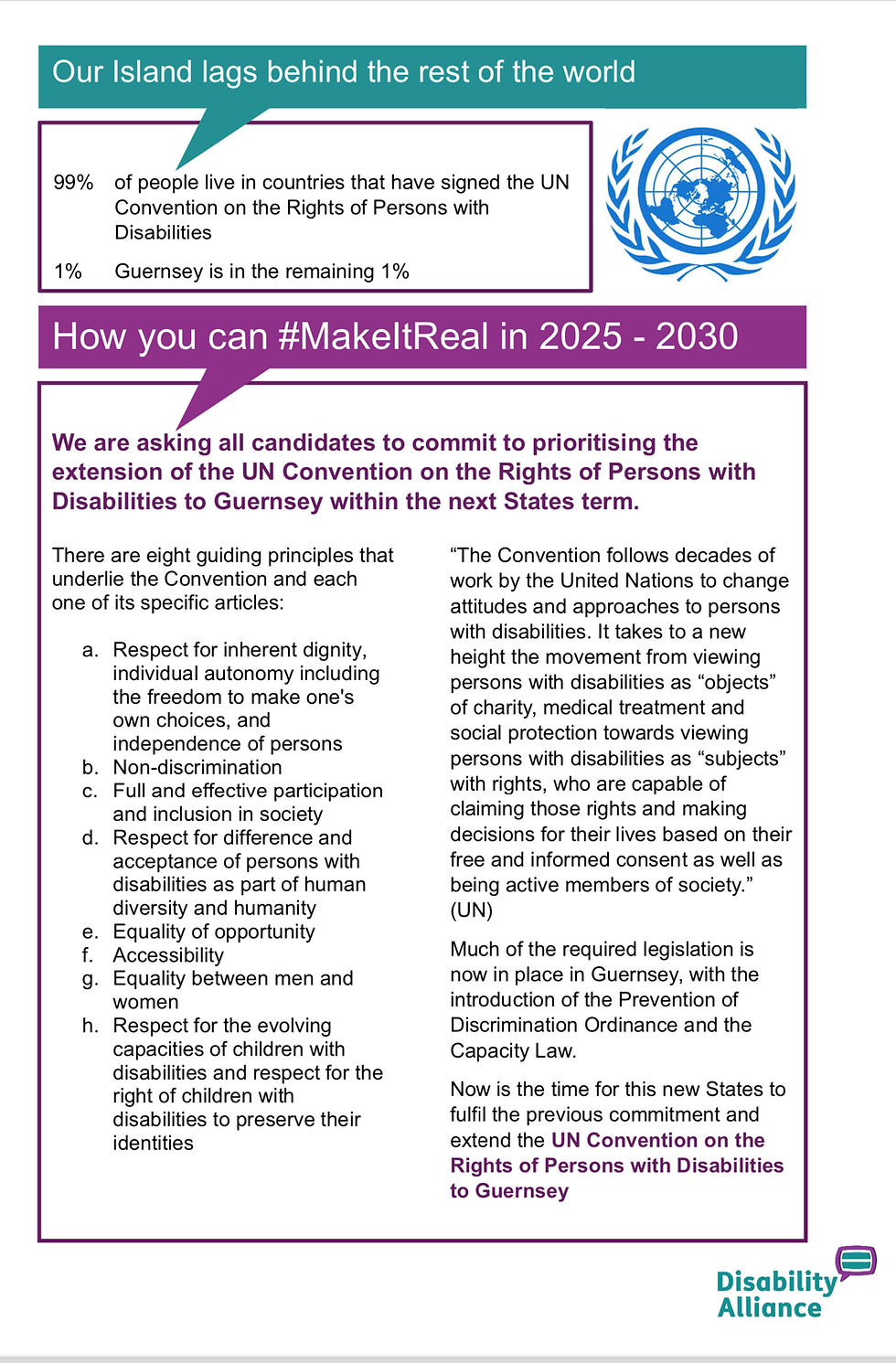
In the lead-up to this election, I have been asked by the Guernsey Disability Alliance (GDA) to support the call for Guernsey to finally extend the United Nations Convention on the Rights of Persons with Disabilities (UNCRPD). This is a commitment the States made in principle over a decade ago. In that time, much has changed — but for many disabled islanders and their families, not enough has changed fast enough.
I wholeheartedly support the extension of the UN Convention, and I believe the eight guiding principles at its heart should be embedded in all our laws, policies, and services:
Respect for dignity, autonomy, and independence
Non-discrimination
Full and effective participation and inclusion in society
Respect for difference and acceptance as part of human diversity
Equality of opportunity
Accessibility
Equality between men and women
Respect for the evolving capacities and identities of children with disabilities
These are not abstract ideals. They are practical, human principles that should guide how we design everything from transport to education, housing to healthcare.
Delivery Must Come First
That said, I do believe we must be honest about capacity. If faced with a direct choice between investing time and resources into signing paperwork versus delivering real, on-the-ground services for people with disabilities, I would prioritise delivery. However, I also recognise that signing up to the Convention is not just symbolic — it sets a framework for accountability, and without that framework, rights can be overlooked.
Words Must Be Matched by Action
At the recent Disability Hustings organised by campaigner Aindre Reece-Sheerin and Dr Rob Harnish, Director of the Ron Short Centre and candidate, it was pointed out that only 2 of the 82 candidates had explicitly mentioned the 20% of our population with disabilities in their manifesto. I was one of those two.
Here is what I wrote in my manifesto:
"Building a stronger Guernsey means making sure that every Islander has the chance to contribute, not leaving anyone behind. During my previous term in the States, I was proud to serve as Champion for Disabled Islanders and to play a part in bringing forward Guernsey’s first Disability and Inclusion Strategy, and the development of the Equalities legislation.
But real inclusion does not end with legislation. Passing laws is only the beginning. We must ensure that the rights we enshrine are genuinely realised in people's lives. Disability access must be embedded into all public infrastructure planning, not treated as an afterthought. Employers must be supported to make workplaces genuinely inclusive, not simply compliant on paper.
Inclusion is not a cost. It is an investment. Equality, inclusion and human dignity are not separate from economic strategy, they are economic strategy.
The goal must always be to empower Islanders, not simply to tick boxes. Rights-based, light-touch, carefully monitored legislation is essential. Government must not simply legislate and move on — it must stay engaged, listening, measuring, and adjusting to ensure we are truly building a community where every Islander has the opportunity to thrive."
My Pledge to Islanders with Disabilities
If elected, I will:
Push for the progressive realisation of the Convention’s principles across all areas of government.
Support the formal extension of the UNCRPD, ensuring it is matched with real action and resources.
Fight for better services, greater accessibility, and inclusive decision-making — not just in policy, but in practice.
Continue to meet and listen to disabled islanders and their families, as I have throughout this campaign, so that voices are heard and solutions reflect lived experience.
Guernsey has made progress. But we are still one of the few places left in the world not to have signed the Convention. That is not good enough. We must do better — and we can.
Let’s deliver an Island where every person can participate fully, with dignity and independence, and where rights are not just promised, but protected.



Comments